

A Village Shaped by Time
Lofou’s story reaches far beyond its cobbled streets and stone-built houses.
Archaeological evidence suggests that the wider area was inhabited as early as the Bronze Age, although the precise date on which the village itself was established remains uncertain. Official Cyprus tourism material likewise recognises these ancient roots while celebrating Lofou for the historic architecture and traditional character visitors encounter today.
Yet the history of Lofou is perhaps best understood simply by walking through it.
Old façades, timber doors, stone stairways and narrow lanes reveal a village shaped gradually by the people who lived, worked and raised their families here.
History in Lofou doesn’t feel distant.
It surrounds you.
Architecture with a Story
The Stone-Built Character of Lofou
One of Lofou’s most distinctive qualities is the remarkable harmony of its traditional architecture.
Stone houses gather along winding cobbled streets, adapting naturally to the slopes and contours of the hill on which the village developed. Cyprus’s official tourism authority identifies Lofou particularly for its old architecture and winding cobbled streets, which remain fundamental to the character of the village today.
Look more closely and the smaller details become just as interesting: old entrances, enclosed courtyards, wooden shutters, balconies, tiled roofs and stonework bearing the traces of generations.
Many buildings have since been carefully restored, allowing Lofou to evolve without losing the architectural language that makes it distinctive.
This philosophy of preservation is also at the heart of Oinoessa, where historic family buildings have been restored so their original character remains part of the experience.
Lessons from Another Time
The Old Primary School
Among Lofou’s most recognisable heritage buildings is its old Primary School, an impressive stone-built landmark overlooking the village.
For generations it was part of everyday community life, filled with the voices of local children until the school ceased operating in 1973.
Its significance did not disappear when the classrooms fell quiet. The school remains an important village landmark and has continued to provide a setting for community and cultural events. Official Cyprus tourism information still identifies the old school as one of Lofou’s principal places of interest.
It is a simple but evocative reminder that Lofou’s heritage isn’t only found in grand monuments.
It also lives in the places where ordinary village life once unfolded.
From Olive to Oil
The Traditional Olive Press
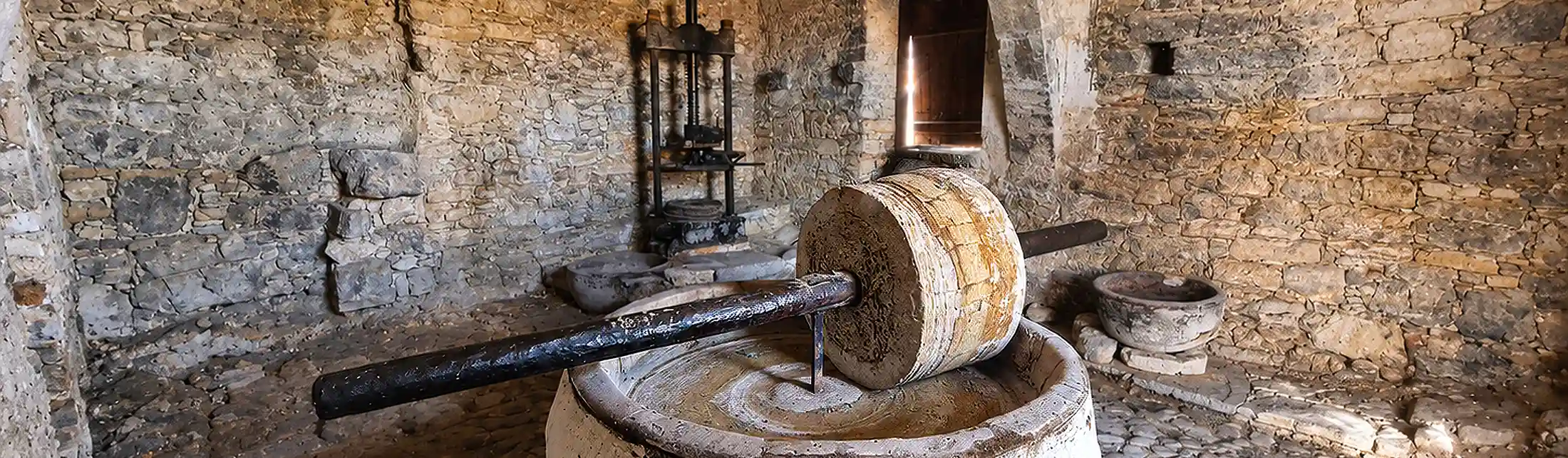
Agriculture shaped life in Lofou for centuries, and the village’s historic olive press offers a fascinating glimpse into that working past.
The original Oinoessa records describe a stone building containing the equipment once used to transform harvested olives into oil, including the stone mill, millstone, iron press, storage utensils and the traditional niskia used for heating water.
Rather than displaying history as something abstract, places like the olive press reveal the practical rhythms of rural life: growing, harvesting, pressing and storing what the land provided.
Official Cyprus agrotourism material continues to include the village Olive Mill and Agricultural Museum among Lofou’s places of interest.
Together, they preserve another part of the relationship between Lofou, its people and the surrounding countryside.
Together, they tell a much larger story, of how generations lived from the land, built their homes, educated their children and created the village that visitors experience today.
And after exploring that history, you can return to Oinoessa and experience a small part of it for yourself.