

Faith, Architecture & Village Life
Panagia Chrysolofitissa
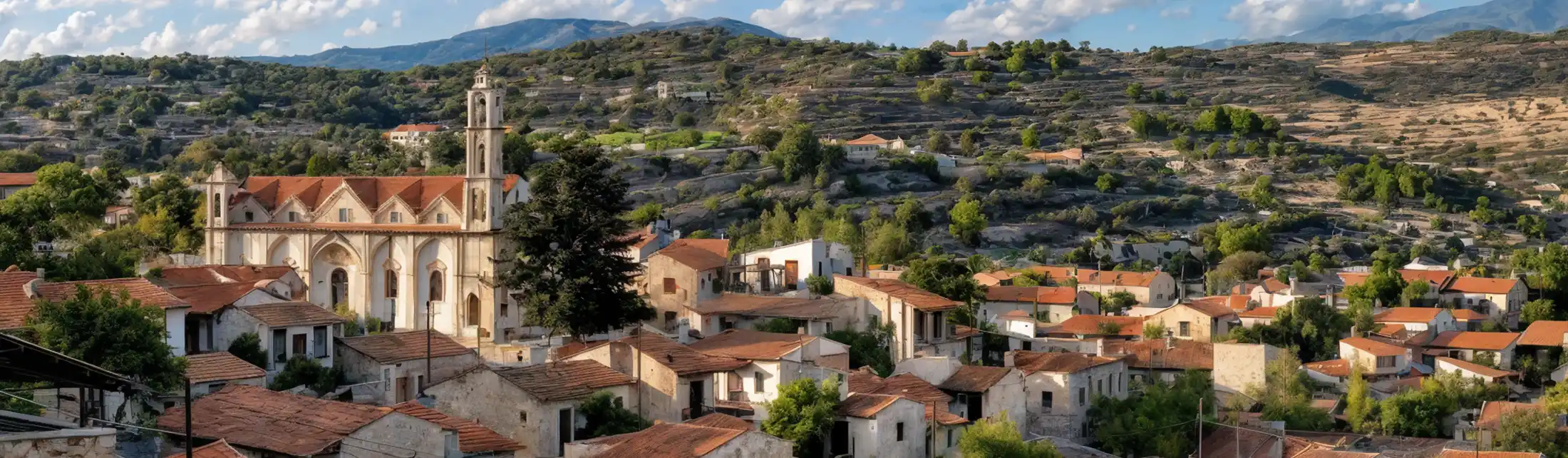
Standing prominently on a hill to the west of the village, Panagia Chrysolofitissa is Lofou’s principal church and one of its most distinctive landmarks.
Dedicated to the Annunciation of the Virgin Mary, the church was built during the 19th century, with construction beginning in 1854 and completing in 1872. Its architecture includes Gothic influences, while two stone bell towers, completed in 1910, frame its exterior.
Inside, religious paintings, carved woodwork and historic icons reflect the church’s long spiritual connection with the community. The original village records describe two particularly old icons of the Virgin Mary, traditionally dated to the 11th and 16th centuries.
More than a historic building, the church remains an enduring expression of Lofou’s faith and identity, a landmark that has watched over generations of village life.
A Quiet Corner of Lofou
The Chapel of Agios Georgios
Close to the traditional centre of Lofou, west of the village, stands the small Chapel of Agios Georgios.
Renovated in 2000, the chapel contains a large icon of Saint George painted by the Mount Athos monks Kyrillos and Nimfonas. Beside it lies an old cemetery with carved stone graves, some of which are recorded as protected monuments.
Its scale and setting offer a quieter contrast to the village’s principal church.
It is precisely these smaller places that reveal another side of Lofou’s religious heritage, intimate spaces closely connected with the families and generations who have called the village home.
Faith Above the Landscape
The Chapel of Prophet Elias
Set on elevated ground south of Lofou, the Chapel of Prophet Elias combines religious tradition with one of the area’s beautiful countryside settings.
The chapel stands along the road approaching Lofou from Alassa, with views stretching across the surrounding landscape towards Kouris Dam and the distant coast. It was renovated in 1999 and contains an icon of Prophet Elias painted by Cypriot hagiographer Othonas Giavropoulos.
Local religious tradition gives the chapel another layer of meaning. Cyprus’s official tourism authority records a belief associated with the icon of Prophet Elias and the protection of grain crops from damaging rainfall.
Whether approached for its religious significance or its peaceful position above the countryside, it is a lovely place to experience the quieter landscape surrounding Lofou.
Beyond the Village
Agia Marina & Agioi Pateres
Further into the countryside, two smaller chapels extend Lofou’s religious heritage beyond the traditional village core.
The Chapel of Agia Marina, around three kilometres southwest of Lofou, was constructed between 1983 and 1985. Local tradition holds that a deserted monastery once occupied the area where the chapel now stands.
Northwest of the village is the tiny Chapel of Agioi Pateres, associated with a cave where pottery and human remains were reportedly discovered during construction. The original village account also recalls a candle that villagers had traditionally kept burning within the cave. Today, the small chapel contains numerous donated icons, and community vespers are traditionally held there on the eve of the feast of the Holy Fathers in October.
Together, these modest countryside chapels show how deeply faith is woven into both the landscape and traditions of Lofou.
Exploring Lofou’s churches and chapels is as much about discovering the village as it is about visiting individual monuments. Each tells something of the people who lived here, the traditions they preserved and the landscape they called home.
Afterwards, return through the stone lanes to Oinoessa, settle into the quiet of the village and let another day in Lofou come gently to an end.